
Identity area
Identifier
Authorized form of name
Parallel form(s) of name
利銘澤典宬
Other form(s) of name
Type
Contact area
Type
Address
Street address
Locality
Region
Country name
Postal code
Telephone
Fax
Description area
History
Our History
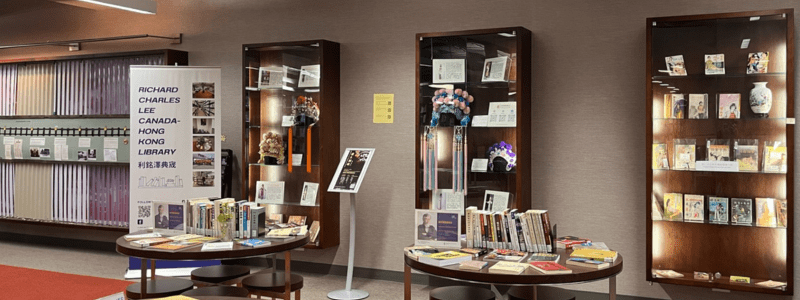
Richard Charles Lee Canada-Hong Kong Library (利銘澤典宬), officially launched on March 6, 2008, is the successor of the Canada-Hong Kong Resource Centre (加港文獻館). CHKRC was established in November 8, 1994 to house the data and reference materials collected by the Canada-Hong Kong Resource Project (加港研究計劃). Initially operating under the Joint Centre for Asia Pacific Studies (JCAPS), the Resource Centre became a part of the University of Toronto Libraries as JCAPS dissolved and transitioned to the York Centre for Asian Research. The Resource Centre first relocated to Room 8001 in the John F. Robarts Library [in 2003]. Following a generous endowment by hon. Vivienne Poy, it became the Richard Charles Lee Canada-Hong Kong Library, opening in its current location on March 6, 2008. It was supervised by founding Director Jack Leong (梁恒達) between 2007 to 2020 and second director Maria Lau (劉麗芝) from 2022.
The Library inherited the Canada-Hong Kong Project database and had collected extensively on materials related to the history and culture of Hong Kong. It provides resources and space to accommodate the continuous growth of research interest in Hong Kong and its relation to Canada. Its holding includes over 40,000 books, 5000 periodicles, and archival materials, making it the largest research library of its kind outside of Hong Kong.
Geographical and cultural context
Mandates/Sources of authority
Administrative structure
Records management and collecting policies
Buildings
Holdings
Hybrid Collections of Archives, Books, and Periodicals
In conjunction to 80,000 volumes of books and periodical titles at the Richard Charles Lee Canada-Hong Kong Library, the newly launched Hong Kong Archives (香港檔案特藏) feature a wide range of archival materials that document the history, culture, and lives of Hong Kong and its people. There are now 7 fonds open for use by appointment, totalling 3.5 m of textual records, 27000 photographs, 500 audio visual tapes, 90 artifacts, and 15 GB of digital records.
Finding aids, guides and publications
Getting Here
Consult our online instruction or see tips below after your appointment is confirmed:
- We are located at 8th floor, Robarts Library, 130 St. George Street, Toronto. Please see here for the details of getting to our library.
- Enter through the main entrance, check-in with John F. Robarts Library security with the confirmation email and a piece of valid photo ID
- Take elevator to the 8th floor, check-in with our front desk at Richard Charles Lee Canada-Hong Kong Library
- For first-time user, we kindly ask that you review and sign the Acknowledgement of Research, Reproduction, and Copyright Rules form
What to Bring?
You are recommended to bring the following for the convenience of our staff and yourself:
- The confirmation email we sent you (digital copy accepted)
- A piece of valid photo ID
- Your personal device, such as laptops, tablets, cameras, or cellphones
- Your personal notebooks and pencils
What not to Bring?
The following items are not permitted in our research area. But our staff can secure your items as you check-in at the front desk:
- Food and beverages
- Electronic storage devices, such as USB and hard disk
- Any stationery other than pencils, such as pens, markers, highlighters, erasers, correction fluid etc.
- Personal belongings not necessary for research, including backpack, handheld purse, laptop case, coat etc.
Using the Archives
Our archives are unique and carry the weight of time. We appreciate that you handle the materials with care. Here are the general guidelines for using the archives:
- Do not rearrange the order of the materials yourself
- Avoid writing over the archival materials
- When viewing photographic records, wear the nitrile gloves provided to you
- When viewing textual records and three-dimensional objects, gloves are not required but you should keep your hands clean and dry
- When viewing digital or audio-visual materials, a workstation can be provided as needed
How to Cite
You are responsible for accurate citation of any archival materials quoted or used. Chicago Manual of Style and MLA did not specify how archival documents should be cited, you are encouraged to follow our preferred style as follows:
Title of records, date, reference number, title of fonds/collection, title of repository.
Example 1:
Records about British Nationality Bill, 1977-1981, CHKL04-01-05, Sir Kan Yuet-keung Archives, University of Toronto Richard Charles Lee Canada-Hong Kong Library.
Example 2:
Historical figures and fact sheets of Hang Seng Index, 1985-1987, CHKL03-01-03, Stanley Kwan Archives, University of Toronto Richard Charles Lee Canada-Hong Kong Library.
However, if you are following the APA convention, there is a complete guide on citing archival documents and collections. Please refer to https://apastyle.apa.org/style-grammar-guidelines/references/archival.
Access area
Opening times
Wednesday to Friday 12:00 pm - 4:00pm during test launch
Book Your Appointment — Hong Kong Archives Appointment Request Portal
Access conditions and requirements
- An appointment is required to use the archives
- Appointment request should be made no less than 5 business days before your visit
- You will receive an email in 2 business days to follow-up with your request
- Approval is subject to the discretion of the archivist, which depends on availability of the materials, space, and restrictions as required by law or donors
- All appointments are in-person, remote access is not currently supported
- You can request a research consultation when making the appointment
Accessibility
Services area
Research services
Reproduction services
Copyright, Reproduction and Photography Rules
You are permitted to take non-flash photographs with your cameras or smartphones. Photocopy and digital scan of the archives are not supported.
Use of digital photographs taken with your personal device is subject to the regulation of Canada Copyright Act. Please note the following important reminders:
- Your photographs can be used for research, private study, education, parody, satire, review, criticism, and news reporting under fair dealing exceptions (section 29, 29.1, and 29.2).
- For purposes other than those exempted by fair dealing, you are fully responsible for identifying the copyright holders and obtaining the necessary permissions or licenses
- The Richard Charles Lee Canada-Hong Kong Library cannot grant authorization for works that we do not hold the copyright